Αυγουστίνος Καντιώτης


Archive for the ‘English’ Category

WHAT IS PAPISM?

author Posted by: episkopos on date Ιουλ 31st, 2010 | filed Filed under: English

WHAT IS PAPISM?

(TI EINAI ΠΑΠΙΣΜΟΣ)

ΟΡΘΟΔΟΞΙΑ istWithout reservation we say that papism is a toppling of the fundamental laws of the Church, of genuine Christianity. And behold why.

According to Scriptures, the root, head, and foundation upon which the entire Christian edifice is supported is the God-man Redeemer, our Lord Jesus Christ. He is the Alpha and the Omega of our faith, of our hope and of our love. He is the Leader. The voice of the Father heard twice from heaven, at the Jordan river and on Mount Tabor, established Him as eternal Leader in the Church: “This is my beloved Son, in whom I am well decided; listen to him” (Matt. 3:17; 17:5). The faith in Christ, the active faith, which is exhibited through absolute obedience to his commandments, even the least of them, is a fundamental law of the Church. Without this faith the Church can not be conceived.

Moreover, a fundamental law in the Church, which the God-man Lord established, is: as often and whenever among the faithful there appear serious disagreements concerning things of the faith, things that need to be done, worship matters – these differences are not solved by one only member of the Church, however official is his position, holiness and wisdom might be; but these matters are solved by the collective whole, by the Church, coming together and convening in holy Spirit (Matt. 18:17). According to this manner, that argument concerning circumcision, which shook up the apostolic Church, was solved, during which both Peter and Paul and the rest of the apostles and disciples spoke and developed their views on the subject; but when the decision was made, all subjected themselves to the voice of the Church (Acts 15:6-29). No one of them set his own authority above the authority of the Church. The infallible criterion in the Church, even when the chiefs of the apostles were living, was the Synod (Council).

But both of these fundamental laws, which pertain to the administration of the Church, papism overturned. In the Church the leader is the pope. In the Church the pope possesses infallibility. In the Church the pope is everything. Being driven by the demon of luciferian pride the pope usurped all the authorities, set his throne above the clouds, opened his mouth and, as another Nebucadnezzer, said: Nations and peoples, do you see me? Fall down and worship, pay homage to me. “By divine right” I am above lay people, monastics, deacons, priests, bishops, metropolitans, archbishops, patriarchs, regional and even those ecumenical Synods. When I am found on my seat and speak, I speak in holy Spirit and my decisions are infallible. I am the one and only, unique referee of Christ upon the earth. The soldiers who are faithful to me preach to the whole world the motto:

“Just as one God exists, one sun for the day, one moon for the night, in like manner God gave to the Church only one leader, the pope.” But not only ecclesiastical, but also political leaders obligated to obey me in all things. The two swords in the Gospel (Luke 22:38) symbolize the spiritual and worldly authority, and I must hold and use these two swords. Every authority comes from me. Woe unto the one who set himself against my volitions…

The pope, being clad with such ideas, established in the world a tyranny, a tyranny in the name of the Crucified One, whom he would say, that he and only he would represent upon the earth. And this tyranny ended up being unbearable, especially when upon the papal throne there sat individuals, who had no internal relation with the Christian faith and life. Popes thieves and robbers, making unrestrained use of power, brought huge corruption to the flocks of the West. The people murmured. The godly would sigh. Courageous preachers of the divine word, who dared to protest against the antichristian live and conduct of the popes, were apprehended and burnt alive, as the famous Jerome Savonarola (1452-1498), whose statue adorns today one of the squares of Florentia. Rome, with the corrupt and unfaithful popes, who abolished every evangelical virtue, would appear already in the eyes of the peoples of the West as the whore of the seas, as the new Babylon. Finally the volcano of the wrath of the peoples erupted. In 1520 a revolution was preached and the strong struggle against the papists began. At the head of the struggle was Martin Luther, concerning whom Thomas Carlyle writes, that Luther took the ax of truth and with the surge of a hero attacked and crushed the idol of papism. The struggle lasted many decades. The civil war was raging. Blossoming cities were transformed into smoking ruins. The blood ran like a river. And the cause, the most serious of all, of that big disaster, which struck Europe, was the foolish, the antichristian ambition of the pope, so that all might fall down and embrace the edge of his foot and recognize him as the only leader of the Church upon the earth.

The popes, if they had even an ounce of real godliness or true piety, would be ashamed in projecting such foolish and antichristian ambitions, and, the worst of all, struggling for the enforcement of them upon the totality of Christianity. He who studies the history of this period oftentimes remembers J. Chrysostom, who, lamenting on account of the bad situations of the ecclesiastical divisions would preach, that the chiefest cause of them is the controlling-spirit, philarchia.

“Nothing is capable of dividing the Church thusly as the controlling-spirit, nothing thus kindles the wrath of God as the dividing of the Church” (See 11th homily on his commentary on the epistle to the Ephesians: P.G 62.85).

+ Archimandrite Augustinos Kantiotes, 1956

Open Letter to Patriarch

author Posted by: episkopos on date Ιουλ 27th, 2010 | filed Filed under: English, ΟΡΘΟΔΟΞΙΑ

Year 61 – ATHENS – March-April – 1985 – Page No. 438

WE SEEK A FREE AND VIBRANT CHURCH

Editor-Publisher

Augustine N. Kantiotis


CHRISTIAN SPARK

  • “If someone comes toward you and bears not this teaching, accept him not into your home, and greet him not.” (2 John verse 10)
  • “For heretics things sacred are untreadable” (From the interpretation on the 6th canon in the Laodikeia canon)“The advocate of the religion is that very body of the Church, that is that (faithful) people’ (Response – Encyclical of patriarchates of 1848)

ΟΡΘΟΔ. ιστ

OPEN EPISTLE TO THE ECUMENICAL PATRIARCH

MR. DEMETRIOS [*]

  • [*] This was published in issue no. 438 of March-April 1985 page of the periodical “Christian Spark”. From the year 1972, after the death of Athenagoras, upon the ecumenical throne of the patriarchate of Constantinople is found, as we said, another patriarch. Despite the change, however, of the person at the peak of Orthodoxy and despite the confessedly peace-loving and humble successor of Athenagoras, his all-holiness mr. Demetrius, the line followed has in no way changed. Indeed the ecumenical activities and violations of the sacred canons have intensified to the point, that all who pain on account of Orthodoxy are becoming very anxious and are orienting themselves towards avoidable activities, as was that of the three in action bishops going under the jurisdiction of the new lands (of the ever-memorable metropolitan Eleftheroupolis mr. Ambrose, of the metropolitan of Paramythias mr. Paul and of the present writer), cutting off the commemoration of the name of the patriarch Athenagoras from the year 1970 and afterwards. This present letter constitutes an expression of this agony, which 23 years after the preceding letter to Athenagoras (1962), will come to also ring the bell of danger to mr. Demetrios.

Your all-holiness,

By the grace of God, by the mercies, and pities of the all-good God, the present writer happens to be a bishop of the Orthodox Church of Christ. For eighteen consecutive years I serve in this end region of Florina and try to properly respond, as much as I am capable of doing, to my most weighty episcopal duties in these hard times, during which huge waves of materialism and atheism rise up and strike against the sacred ship of the autocephalos church of Greece.

Concern for the whole Church

Now these duties would be capable of sucking my entire interest as shepherd having the responsibility for the perdition even of one only soul, on account of which the blood of the God-man was shed. But as member of the Hierarchy of the Orthodox Church I am not capable of remaining indifferent, also, regarding everything and anything that occurs in the entire region of the Orthodox Church, which spreads her branches even unto the five continents. For according to the teaching of the chief of the apostles, Paul, those belonging to the Church constitute a singular body, the body of Christ, and “when one member suffers” (1 Cor. 12:26), the rest of the members must co-suffer, and indeed particularly those members, which have a protruding, prominent position, as the head. And, as the ecumenical teacher of the Church, John the Golden-mouthed, (Chrysostomos), says that, if a thorn  plunges into the sole of a foot, the whole body slouches, and the head leaves its upright position, it is humbled and bent over towards the suffering member and makes every effort for the removal of the thorn. In like manner, observes the sacred father, it must occur in the Church of Christ. If, that is, one member of the Church runs the risk of undergoing some serious danger, all the members – for yet a greater reason the bishops – are in duty bound to display vitally their interest towards the therapy of the evil, so that this does not evolve into gangrene, threatening the whole body.  But even the prayers, which every regional church sends forth in behalf of all the rest of the member-parts, the orthodox churches, as well as the remembrances, which are done in the services, constitute a proof, that all the Christians, and indeed bishops, must not limit their interest to the borders of their small areas, but to extend that interest unto the ends of the earth, in which orthodox people dwell. Indeed the same sacred father, John Chrysostom, in weaving an encomium to saint Efstathion, bishop of Antioch, says concerning him that his interest used to extend beyond the bounds of his bishopric.

For “he had received good paideia (education; culture; learning; right nurturing) by the grace of the Spirit, for being in charge of the Church not only there [in his own bishopric,] was he in duty bound to rule, which he was ordained by the Spirit to do, but also [to rule] every (church) subsisting in the inhabited world; and he learned these things from the sacred prayers. For if he must make prayers, he says, in behalf of the catholic Church, which is from one end of the inhabited world to the other, how much more does he also have to show providence in behalf of all of her (the Church), and in like fashion to lead and care for all” (See Greek Fathers Mign 50, 602).

It is, then, a sacred duty, of the most sacred duties, for every bishop of the Orthodox Church to actively observe with interest, attention and anxiety everything and whatever happens in the orthodox sphere, and to contribute to its spiritual progress. Woe if the bishop becomes enclosed within the narrow bounds of his bishopric and remains completely indifferent towards the general state of the Church, contenting himself with the idea that the voracious fire of errors, of heresies and of atheism, which happen to set aflame all the bishoprics, will not reach in a short time his region, too.

The one studying the sacred canons of the Church with amazement observes that, though these (canons) prohibit the intervention of a bishop in the administrative duties of other bishoprics, yet, nevertheless, there does exist the case, according to which, altogether exceptionally, not only is it allowed, but it is demanded, that bishops, besides the prayers, petitions and admonitions, display their more vital interest in behalf of other bishoprics. And this very case is when a bishop of one eparchy, though he sees the wave of heresy threatening his eparchy, does not only take no measure whatsoever, but remains completely neglectful and indifferent; or, what is still worse, he co-agrees, [consents, and collaborates] with these heretics and utters words insulting the orthodox faith (See canons 121 of the Synod of Carthage and the 15th of the First-second [Synod]). The struggle in behalf of orthodoxy, as we see, demands still more, manifestations of extraordinary activity, which, though they are found to be outside the usual scheme, not only are not condemned, but are praised. And even as ecclesiastical history testifies, because of such manifestations and operations in behalf of the patristic piety, whole regions were saved, which were in danger from the expansion of heresies.

The Church in the Face of Heresies and Schisms

If, your all-holiness, the above [considerations] are taken seriously into view, then my present epistle will not be considered a [kind of] superseding of duty or as an intervention into the duties of others, but as an expression of the unrest of an elder High-priest, who, on account of his position, has spiritual dependence, too, from the Ecumenical Patriarchate. He for already half a century by means of the grace of God is working in the vineyard of the Lord, and on account of his oral and written preaching, comes often into communication with the more broad strata of the people.

With all due respect, then, which we have for the Ecumenical Patriarchate, let it be permitted us to say, that the contemporary state in general in the orthodox sphere, and particularly in the region of the jurisdiction of the Ecumenical Patriarchate, judged by orthodox criteria, as are the sacred canons, is not at all pleasant, but engenders great dangers. And behold why.

According to our faith, which for centuries we declare in the Creed of the Faith, the Church is ONE (“I believe…in one holy, catholic, and apostolic Church”, 9th article of the Symbol of faith). And this very same ONEChurch is our holy Orthodoxy, which preserves as a priceless treasure the sacred deposit, which the Lord gave to her through his holy apostles and through the ecumenical and regional synods. Concerning this deposit, the apostle Paul writing to his disciple and bishop of Ephesus Timothy, says:

“O Timothy, [keep vigilant] guard over the deposit, derailing the sacriligious vain-voices and contrieties of pseudo-knowledge, by which certain ones in declaring them concerning the faith, have missed the mark.”

Now in the response of the great Church of Constantinople to the encyclical of the pope of Rome Leontios 13th, during the year 1885, we read the following characteristic remarks.

“Christ-loving peoples of the glorious lands of the West! … The redeeming faith in Christ for all time ought to be correct in every respect and according to the holy Scripture and the apostolic traditions, upon which is based the teaching of the divine Fathers and the seven holy and god-selected Ecumenical Synods. It is obvious to the aforementioned that the entire Church of God, which contained within her bosoms the singular and unadulterated and wholesome salvific faith as a divine deposit, … this same Church is one and singular unto eternity, and not some multiple and variegated with time product; insomuch that evangelical truths do not accept variation or progress in time, as do the various philosophical systems, because “Jesus Christ is the same yesterday and today and for ever more” (Hebrews 13:8)” (See “The Dogmatic and Symbolic Monuments of the Orthodox Catholic Church” by John N. Karmiris, vol. 2 Athens 1953, p. 944).

And as an ever-memorable High-priest, a fervent lover of Orthodoxy, used to say,

“this same deposit contains everything and whatever our Orthodoxy has that is sacred: dogmatic exactitude, god-taught ecclesiastical commonwealth, sacred and holy traditions, a long and glorious history.”

The Church is ONE, the Orthodox Church. Besides her all the other religious forms are heresies or schisms. And they are improperly called churches. Now what should the relation of the Orthodox Church be towards the other confessions-heresies – this constituted the initial issue of discussion in regional and ecumenical synods. These same [synods,] in interpreting the teaching of the New Testament, and particularly a certain few of its characteristic passages, (as, for example, Math. 7:15; 16:6; Titus 3:10; 2 John verse 10,), articulated in the form of sacred canons and ordained, on penalty of defrockment (unrobing) or excommunication, the mind-set and stance of orthodox before heretics. Behold the text of the above passages:

  • a) “Beware of the pseudo-prophets, who come to you in sheep’s clothing, but within are ravenous wolves” (Math. 7:15).
  • b) “And Jesus said to them: Look (out for yourselves) and be careful, (keep guard) from the leaven of the Pharisees and Sadducees” (Math. 16:6).
  • c) “Quit (communicating with) a heretical man after the first and second admonition” (Titus 3:10).
  • d) “If somebody comes to you and bears not this teaching, do not accept him into your home, and do not greet him” (2 John verse 10).

Shall we, here, also call to remembrance the sacred canons? They are known to every bishop. We call to remembrance, however, certain ones of them, the following. 45th, 65th of the holy Apostles, of the 1st and 3rd Ecumenical Synod, and the 6th, 9th, 33rd, and 37th of the Synod of Laodikeia (See “Pedalion” published by “Asteros”, Athens 1957, pp. 50-51, 84-85, 170-171, 422, 433, 435). By the sacred canons, then, as many annotated and interpreted  them, distinguished canon law specialists and interpreters, among which, also, is saint Nicodemos the Hagiorite, it is prohibited literally for heretics to enter into the sacred churches of the orthodox (“what is sacred is not to be treaded upon by heretics”); prohibited are: common concelebrations, joint prayer, addresses and counter addresses in the sacred churches: prohibited is the exchange of gifts between orthodox and heretics; prohibited is the entrance of orthodox into synagogues (congregations) of Jews or heretics, as also into conventions of apostasy [*].

[*] Of these sacred canons called to remembrance we cite herein the text of one only (the 6th Canon of the Laodiceia Synod), as well as the interpretation, which was composed by saint Nicodemos the Hagiorite, as also the related, relevant commentary from the sacred-canonical book “Constitution of Divine and Sacred Canons” of the authors G. Ralli-M.Potli (vol. III. Athens 1853, p. 176).

CANON 6 (Text): “Concerning the non allowance of heretics to enter into the house of God, who persist in heresy.” Interpretation (Nicodemos the Hagiorite); The ordinance of the present Canon is for heretics not to have license, permission to go inside the sacred temple of God, which is held by Orthodox, that is, if they persist in the heresy and do not want to return” (See “Pedalion”, publication of “Asteros”, Athens 1957, p. 422). Commentary (from the above mentioned book of Ralli-Potli); “Those who have fallen into heresies, and remaining in them, are ostracized from the Church, as being aliens” (Zonaras). “Heretics are not to step on what is sacred. It is not allowed for heretics to enter into the house of God…” (Aristenos).

Are the Sacred Canons [Kept and Actively] Observed?

And we ask: These sacred canons, which were put together in holy Spirit by god-bearing fathers, whose shoe laces we modern fathers are unworthy of untying, are in force or not in force in the Orthodox Church? Yes or no? If not, then honorably and with straight talk it must be said and it must be indicated, which organ superior to ecumenical and regional synods took such a more modern decision. For it will constitute an example of the ultimate hypocrisy, for the bishops, on the one hand, during the dreadful hour of their ordination to promise that they shall [vigilantly keep or actively] observe them without deviating, but in practice though, to trample them underfoot flagrantly and to provoke in this way the astonishment of the remaining faithful, who in this century of faithlessness preserve the kindlings of Orthodoxy, as the canon (rule) of faith and life. If however, the sacred canons continue to be in force, then these canons should be enforced in practice and every person that dares to stray away from their line should undergo the demanded annulments. To this question there must, at all events, be given an answer. For, it is not concerning an issue which, according to the teaching of the canons, there is room for economy and condescension. This is about the issue related to the faith, concerning the protection of that which is of the orthodox faith from apostates and heretics, who, so long as they do not repent, but persist in their errors, must be found at the canonical, [proper] distance. Now the keeping of such a distance must not be characterized as “misallodoxia” (hatred for people of other views) and harshness, but as an expression of a robust orthodox “phronema” (mentality; mind-set; mental orientation) and genuine Christian love, which through strictness looks to the enlightenment and coming to an awareness of the those in error and their return to the sacred fold. For this kind of strictness, which encloses depth of love, sacred Augustine clamours: “O merciful strictness!”.

Unfortunately, it must be confessed that the hurried and untortured (lax and unexamined) lifting of the anathemas between Rome and Constantinople that took place at the time of your predecessor patriarch Athenagoras, against which very visible hierarchs of the ecumenical Patriarchate protested, without however being heard, opened, as was consequent, the doors also to papism, and to the other heresies and schismatic bodies. The capstones (ceilings; roofs) of the Orthodox Church were abolished. The sacred canons, which ordain, define and regulate the relations of orthodox towards heretics, were trampled upon and are being trampled upon without reserve [shamelessly], and the scandalization coming from this is big. And so that we are not considered to be speaking undefinably [abstractly] and generally, from the many such violations we mention here certain ones, that is, the most known ones.

Samples of Violations

  • 1) The yearly concelebrations by orthodox and papists of the enthronement feast-day of the apostle Andrew (November 30) in the patriarchal church of the Phanar. Also the concelebration of the corresponding enthronement feast-day of the apostle Peter (29 June) in Rome by the papists and orthodox, and during these concelebrations the relative addresses and counter-addresses, and the exchange of gifts.
  • 2) The addresses that are delivered, counter-addresses, and joint prayers in orthodox churches during the visits of the pope in Sydney, Australia (in December of 1970), in Constantinople (the year 1979), in the patriarchal temple of Sambesy in Geneva, Switzerland (in June of the year 1984), and in Canada (in September of the year 1984).
  • 3) The joint prayers and observances of common liturgies by orthodox and papists during the conventions of members of the so-called Theological Dialogue in Patmos-Rhodes (the year 1980), in Monacho of Germany (in July of 1982) and in Chania-Crete (end of May – beginning of June of the year 1984).
  • 4) The observed joint prayers at the conventions of the “World Council of Churches” (W.C.C.), as also at its last general convention performed in VancouverCanada in the fall of the year 1983.
  • 5) The exchanging of gifts from time to time between papists and orthodox high-priests in Rome and elsewhere, on the occasion of various occurances (visits to the Vatican, the returning of sacred relics on its [Vatican’s] part to sacred metropolises of the Church of Greece, and so on).
  • 6) The public and spectacular reception of cardinal Vilemrants by the orthodox church of Crete, who followed the orthodox divine liturgy in the sacred church of Saint Mena in Heraclion, dressed in priestly adornment and finally blessed the orthodox people from the beautiful gate of the above [mentioned] sacred temple.
  • 7) The ecumenical co-prayer or joint prayer of orthodox and papists in the orthodox church of Brussels of Belgium, in which, on the part of the orthodox participated the previous metropolitan of Belgium mr. Aemilianos.
  • 8) The performance of a trisagion by orthodox high-priests of the ecumenical throne before the corpse of pope Paul the 6th who had passed away in the year 1978.
  • 9) The event during the enthronement of the metropolitan of Sweden (of the ecumenical throne) mr. Damascene, of a joint prayer session of orthodox, papists, and protestants in the sacred temple of Saint Paul of Geneva.
  • 10) The referral made during the year 1983 for the transmission of the divine eucharist to the papists by orthodox clerics of the sacred archdiocese of Thyateron and Great Britain, as also the participation more previously (in the year 1979) or orthodox clerics of greater London in an ecumenistical vesper service within the papal temple of Westminster.
  • 11) During the past year (May-June 1984) the reception and entrance into orthodox churches of cardinal of Vienna, Kainich, as also his entrance and his co-prayer or joint prayer held with orthodox in a sacred monastery of Mount Athos.
  • 12) The participation of the metropolitan of Germany, mr. Augustine (Lambardaki) in an ecumenistical worshipful function (blessing of the sweet bread) in July of the passed year 1984, as the newspapers of Stuttgard wrote up.

Towards the Wolves Politeness, Towards the Sheep Austerity?

The above cases, few of the many, constitute flagrant violations and trampling upon the sacred canons, which, if they occurred in other times, when the orthodox faith was robust, they would not be dared, and whichever chance violators would be punished in an exemplary manner. But today they take place publicly and indeed provocatively, and the most scandalous thing of all is this: wherever, that is, orthodox appear, faithful children of the Church, protesting against the violations, these are placed into persecution by their head parish priests of the regional orthodox churches, are excommunicated and punished, and by Hagiorite (Mount Athos) fathers that go about abroad in the diaspora, are placed under austere, strict penances (as the deprivation of the divine communion, and so on.) There are not lacking also even threats against the protesters, as additionally their beatings by those holding opposite views, which remind one of the frightful periods of the Church, during which the heretics were supported and taken care of [in every way], and the faithful were persecuted cruelly or mercilessly, as occurred during the period of arianism. What a frightful thing! Where have we ended up! Heretics of every sort, masons and [so-called] Jehova’s Witnesses, atheists and unbelievers, are not being excommunicated, but faithful children of the Church are being excommunicated, children which, as we said, preserve still the kindlings of the orthodox faith and the patristic piety/godliness. The most rev. of Australia, mr. Stylianos, the most rev. of Switzerland mr. Damascene, the god-beloved bishop of Toronto (Canada) mr. Soterios, and whoever else, forget that, according to the encyclical of the patriarchates of 1848, the faithful “laos,” people is the guardian of Orthodoxy and for no reason whatsoever is it permitted for him to be spurned, reviled or abused. Behold an excerpt from this most important response-encyclical:

“Among us neither Patriarchs nor Synods were capable ever of introducing new [things/lawless innovations], because the advocate or supporter of the Religion is that very body of the Church, that is the people itself, who wants its religion eternally unchanged and of the same form as that of its fathers” (See the cited work “The dogmatic and symbolic monuments of the Orthodox Catholic Church” by John N. Karmires, vol. 2, Athens 1953, p. 920.)

Now, as Basil the Great observes in his famous homily on the Six-day Creation, just as the sheep that grazes in the meadow discerns the poisonous plant and does not touch it quantitatively, thus also the rational sheep of the flock of Christ, however humble the position that they might posses, are taught godwards (from God, theothen) and discern the kind of spiritual food that is offered to them. The remaining faithful people, this remnant of Orthodoxy, today unfortunately is mocked, disdained and excommunicated, while the masons, the papists and the rest of the heretics chance to enjoy affectionate embraces and various forms of [delicate] attending towards the full, as it appears, application of the prohibitive ordinances of the canons of the Orthodox Church which are against this.

Under such circumstances the dividing line between orthodox and heretics is continually weakening and is tending towards disappearance or extinction, and the pan-heresy of ecumenism, according to the ever-memorable Justin Popovitch, is tending to flood Orthodoxy. In the souls of godly/pious priests and bishops of the Orthodox Church there are observed already crises of conscious, about whether, after such deviations – why not also betrayals? – they should continue to commemorate the names of bishops, archbishops and patriarchs, as correctly dividing  the word of TRUTH. A few of them, to be sure, overstress love, saying that, because of love, it is demanded that many retreats and sacrifices be made. But genuine, authentic love is closely conjoined to the truth. It is not enough simply to say that we love, but also to “be true in love” (Ephesians 4:15); that is, to have real love and sincere love, accompanied by the true faith, and for us to look for the spiritual and psychical interest of the beloved [one]. For love without truth, without the faith, is falsehood and deception. Love as a heavenly plant, as a plant rejoicing in truth, takes pleasure, blossoms, and bears fruit only within the truth. And the whole truth, not only a part of it, is found in Orthodoxy.

The orthodox people, found before such kinds of unacceptable manifestations begins already to be in serious unrest. And the black flag, which was raised in some sacred monastery of Mount Athos, as a robust protest on account of the anti-orthodox deviations and manifestations, has touched and moved many.

We do not Threaten, But We Pain and Are in a State of Unrest

Your all-holiness, in finishing already my present epistle, with tears I ask you, as well, also, as the Sacred Synod about you, that you give the necessary attention to whatever an elder presbyter bishop of the Orthodox Church of Greece directs to you, melting his life away in the service of the vineyard of the Lord, and receiving for a long time now a very great many letters of faithful Christians asking for guidance and support. Therefore I also straightway ask you, that you re-evaluate your in the main prohibited stance before the heretics and especially before papism, which, as it speaks and acts, continues to win ground at the expense of Orthodoxy, of which 9/10ths remain unfortunately for a long time under the influence of atheists and totalitarian regimes. It is not the time for unifying endeavors with the heretics. Shut out then whatever entrance to the papists and the rest of the heretics from the orthodox sacred churches, since no proof exists that these people recognize their cacodoxies (false views) nor display sincere repentance. Moreover, prohibit the entrance of orthodox clerics to worship areas of heretics, as well as to Jewish synagogues. The orthodox people throughout the earth, the front-line of battling Christianity – let it come together and close ranks; let it examine and let it solve the problems occupying it; and, to begin with, let it exert itself in its sacred endeavor for the unity of the orthodox world. And if this happens, then the time will come for the outreaches outside the garden of Orthodoxy. Otherwise, if the same situation continues and the violators of the sacred canons, on the one hand, in relation to the heretics remain unpunished, and, on the other, the children of Orthodoxy are threatened with penances and excommunications, how is it possible for the present writer, who for reasons of conscience together with other high-priests had stopped previously the commemoration of your predecessor, how is it possible – I say – now, when the openings towards those outside became broader and already very dangerous, for me to continue to remember your name as rightly dividing the word of truth?

In ringing, then, the bell of danger from this very end of the Hellenic fatherland, I express the agony not only of my flock, but also of thousands of other Christians of Hellas and abroad. Hear these voices as a voice of many waters and do not bring us to the difficult position to cease anew the remembrance of the ecumenical patriarch. Let this not be considered a threat, but as a cry of pain and agony and as the very last petition towards your all-holiness for the immediate return of the great church of Constantinople to that orbit, which in holy Spirit was circumscribed in the ecumenical and regional synods and from which ever-memorable fathers and teachers of the Church, prototypes of true shepherds, did not stray away from the least bit, but sacrificed even their very life in behalf of Orthodoxy.

I undersign reverently

The least brother in Christ

+ Metropolitan of Florina, Prepon, and Eordaias

AUGUSTINE (Kantiotis)

Open Letter to Patriarch:Politeness to Heretics and Harshness to Pious O…


The Most Precious Treasure

author Posted by: episkopos on date Ιουλ 20th, 2010 | filed Filed under: English

The Rose of Purity

by bishop frorina Augustine Kantiotis

The Most Precious Treasure

My Beloved children,

p. Augoust. Kantiotis Kataskin.I have many things to tell you, but here now I will only stress one thing: that you are no longer small children; you’re not little sucklings nor infants nor children of grade school. You are already at the most beautiful but also the most difficult age, the age of puberty. You are 13, 14, 15, and 16 years old. Not big but neither small. And I prove it. One night, with drenching rain, I went to Astrapo, a village that is built on the slopes of the VitsiMountain which is 900 meters high. The inhabitants of the village gathered together and I spoke to them. The women were dressed with the beautiful Macedonian dress, which is the most beautiful and most modest style. So I saw there girls your age being affectionate mothers and holding babies in their bosoms. You’ll tell me, Is it right for them to marry so young? That’s another issue; I don’t examine it here. It has its pros and cons. That which I want to emphasize here is that other girls your age are mothers. Consequently you too, even though you’re not parents, all have, more or less, an idea about sex in our epoch of pansexualism in which we live.

I’m not about to talk to you about sex here. I’ll say only one thing: My children, you are in danger of losing the most precious treasure that you have, your virginity, your purity. Be very careful. You are beautiful buds. Have you seen buds during spring in the gardens? The rose-bush especially has beautiful buds.

A Pig in the Rose-bushes

In one of my earlier travels I remember a gardener, who would tell me a beautiful example. This gardener took care of a beautiful garden. He even placed a fence around it. But one pig that had an appetite for the rose-bushes, wanted to eat them and make them into manure. What, then, did he do? Did he eat them? No, he didn’t eat them. Why? Listen. The pig broke through the fence and entered the flower garden. It fell with a surge upon the rose-bushes, but – O its misfortune! – the rose-bushes had a protector. And their protector was the thorns. The gluttonous swine nailed its face into the thorns; he felt pain, bled and left…

The example that the gardener told me is very suitable, my children, to your situation. You too are rose-bushes. Rational and free rose-bushes of God. But be careful! Your beauty provokes vulgar people, who like unclean pigs surge to tear you apart. And God armed you with a fearful thorn, and that is – as pedagogues and psychologists, who occupy themselves with your age, say – shame.  You have shame and you turn red. If you see a girl that doesn’t turn red, be afraid of her. She is shameless, impudent. Modest girls turn red, lower their eyes before their father, their teacher, their professor, their elder.

God, then, gave you aido (shame). That’s what shame is called in Greek. So see to it well. Whoever approaches you with sweet and beautiful words, small or big or even an old man, take a stick and “soften” his ribs. Your hand will become sanctified. Guard your virginity. Remain pure and untouched until your marriage. Don’t rush; that time will come. All of you will marry. None of you is about to become nuns or missionary persons; these instances are most rare. You will create families and you will be affectionate mothers, just like those up on Astrapo, concerning whom I was speaking previously.

I say to you another thing too. That many girls fell. I don’t condemn them; I weep and am pained for them. They were beautiful buds, and the pigs came and made them into manure. I don’t call them swine, but the Bible does. Many, then, after the skillful, clever ones rung them and threw them like lemons into the streets, came to the metropolis and they cry and threaten suicide. I feel their pain, of course, and I try to console them. But I don’t hide the fact that they too are at fault.

A Beautiful and Modest Custom

Only in the settlement of the gypsies here in Florina, as I also wrote in the “Spitha”, do they have the modest custom concerning this issue. Surely they have their faults too, but they have this good thing. The women marry young and have many children, most intelligent, most capable and red-rose colored from health. When they become engaged, the one doesn’t touch the other until they marry. And when they do marry, they have affection and interest the one for the other. While other young women have no principle, no respect concerning this issue. And the result? Tragic for the women. You women pay the consequences. The unclean swine, who pluck the rose-bushes, don’t care for anything. The girls remain old maids…

A wise sociologist said that, if girls remained pure and held at a distance men who want to amuse themselves with them, then no girl would remain unmarried. Even the ugliest girl would marry. For a man usually cannot live without a woman. But since, without marrying, he finds one and two and three and five and as many as he wants, and does whatever he wants with them, why should he marry? Foreigners who visited Greece, when they returned to their fatherland, said: In Greece everything is expensive: the meat, the fish, the drinks, all the merchandise; only one thing is very cheap, woman’s meat…Goodness, goodness, where have we ended up!

A Heroic Resistance

I entreat you, my children, cultivate among the other good things also the heroic resistance against every “pig”, whatever name that pig might have. Remain untouched, and God will bless you. Your prototype is not only the superb examples of the pure women of antiquity, but especially your prototype is the person of the super-holy Theotokos, who is always set before you as a spiritual mirror. Remain pure and proper in respect to your tongue, your feelings, and your actions. Be proper even in regard to your thoughts.

Why, how in this sinful century will you be able to live such a pure life? You can’t do it alone. Only one power exists, which, if you draw from it, will make you into heroines. It will make you reach marriage undefiled and clean; to become mothers, and to bring into the world genuine children, which will continue the glorious history of this small but martyric nation of ours; and, when you grow old, you shall have unspeakable joy, because in your youth you remained pure and untouched. And this power is the power of our Lord Jesus Christ. It is the omnipotent, all-powerful grace of Christ, whom, you, O young women, praise and exalt unto all the ages.

With paternal wishes,

Augustine (Kantiotis)

Your spiritual father

(A recorded initial address to girls of junior high school at camp in the year 1988. Published in “Student Lightning” no. 121)

+

NO to the Poope!

author Posted by: episkopos on date Ιουλ 16th, 2010 | filed Filed under: English

Kyriaki – Sunday Sermonette

Issue No. 1136, Feb. 5

NO to the Pope!

ΣΤΟΠLast month (January 19, [2005]) we celebrated saint Mark bishop of Ephesus, Eugenicos, who said a “no” to the pope. Today is heard again a “no” to the pope. Some other saint said it, a great teacher and father of the Church, sacred Photios. Concerning him, we shall say a few words.

***

Photios the Great was born in the capital of the Byzantine empire, in the City, about A.D. 810. He lived and flourished in the ninth century – that is, from then 1,000 years and more have elapsed. He was cultivated in a good family environment.

The family plays a significant role. If we open the lives of the saints, we shall see that all these people whose feast-days we celebrate (Basil, Gregory, Chrysostom, Photios…) – all of them came from Christian homes. In the homes back then they said prayers, kept vigil (sleeplessness): the house would become a church. From such sanctified houses came forth the fathers. Then from the houses there came out angels; today demons come out. From where now shall fathers and teachers come out? You parents have great responsibility, who – I have said this thousands of times, I will take this to my grave – I say, you make your little children teachers, professors, officials, lawyers, doctors: who would devote himself to become a priest, a cleric, a missionary? And though Anglo-Saxons, French, Italians have sent down into Africa, to the wild places, their best children, we do nothing of the sort.

And sacred Photios, then, came from a christian home: his father was pious, his mother godly. He was also a noble according to the world. What does noble mean? Not that they possessed riches and offices. The greatest nobility is virtue. So they were virtuous and godly people. And just as our progeny (forefathers) used to say, “No gold upon the earth, or even also below the earth, possesses the value of virtue” (Plato’s LAWS 5,728A); the value of virtue outweighs the value of all the gold in the world. From within such a home came forth sacred Photios. His mother, Irene, and his father, Sergios, were martyrs of the iconoclastic period.

From a child Photios showed that he would become great. He was a child-miracle. He was not simply smart: he was a great genius. Great geniuses are called those people who are capable of delving deep into things and of solving the most difficult problems. Just as Olympus is the highest mountain, thus in like manner great geniuses are the great peaks of the intellect, of the intelligencia. Every 100-200 years there is born a great genius. Great men, high figures, as, for example, Homer, Plato, Aristotle, or in our epoch Einstein.

Sacred Photios was not only a great genius; he was also diligent. He was not like that lazy servant of the parable of the talents, who took the talent and hid it in the earth. Great Photios cultivated his talent. At night he slept for but a few hours. He studied. What did he study? The ancient authors and especially the fathers of the Church: Chrysostom, Basil, Gregory the Theologian…Above all he knew one book by heart: the holy Scripture. His genius and his diligence contributed in distinguishing him into one of the greatest men of humanity. He studied grammar, poetry, rhetoric, oratory, philosophy, also even medicine and every other science. He taught in Constantinople as a wise professor.

Early on he was taken on by the palace and took great positions in the court of Theophilos; he reached becoming the protospatharios, “first-swordsman” (general of the Emperor’s battalion), general secretary of the empire, and consul (parliamentarian).

Suddenly, at the age of 47 he became patriarch of Constantinople, during a difficult time of the Byzantine Empire. Did he want it? He did not want it. He took pleasure in books, the study hall. They took him from there as a layman and they ordained him. When he saw that they persisted, he did not sleep all night. He would weep and say: I prefer to die than to become…Not that he disdained the office of the priesthood, but because he knew how difficult it is for one to lift this responsibility, indeed in such a difficult time. Finally, though, he capitulated. He was ordained in one day, then a reader, sub-deacon, deacon, presbyter, and finally bishop and patriarch on Christmas day of 857. He did not become prideful; he kept himself humble-minded. He had humility. His biography says that whenever he heard that someone had sinned, tears would run from his eyes; he considered his own self to have sinned, and he lamented and begged God to forgive him.

Such was saint Photios, full of love and affection for his flock. But in the face of the enemies of the faith he was a lion. He struggled against the various heresies, and indeed the iconoclasts. He censured and rebuked the rich who were grabbers and unjust. He went against kings and emperors, and this cost him persecution. He had enemies. Who devoured him? priests, despots and monk-elders. They couldn’t take his tongue. All these previously mentioned ones allied themselves against him. They succeeded and brought over to their own side the kings and, and sacred Photios was twice sent into exile. The first time was in 867, during the reign of Basil the Macedonian, at the monastery of the “Protection” at the Thracian shores of the Bosporus; and they prohibited him from bringing anybody else with him. That which cost him dearly was that he was not allowed to have books near him, which always had been his companions. They dethroned him in 869. In 878 he returned for a second time to the patriarchal throne. And again though, they dethroned him in 886, during Leo the Wise’s reign, and they exiled him to a small island near Chalcedon, at the monastery of Ierias. There in exile he closed his eyes on February 6, 891.

Photios the Great said “no” against the pope, who wanted to subject the whole world under his authority. If we today are orthodox, we owe it to sacred Photios. The papists do not want to hear his name; for us orthodox he is a champion leader of the faith, just like Athanasios the Great, like Mark Eugenicos and so many other fathers.

***

Sacred Photios, my beloved, left us something precious, Orthodoxy. That is our greatest treasure. We do not understand this, we do not sense or feel it. A certain saint ascetic of our days said a prophecy: if we continue to live as we are living, a day will come when some shall be franks, others protestants, others masons, others Marxists and atheists, others shall be in different heresies and religions…The many unfortunately are indifferent. Let the Chiliasts or Millenialists [or so-called Jehovah’s Witnesses] increase, what do they care? Concerning these matters, let the priests and bishops attend to them…

It is not thus. You are an orthodox Christian? You must struggle for your faith and beg God. We have a debt. Our fathers toiled how much and sacrificed themselves for our faith! And we today shall become their imitators. When there appears at y our house a heretic and he knocks on your door, immediately inform the metropolis. Heretics and hetero-religionists now are obtaining priviledges [in Greece]: we orthodox will become second class Greeks. They insult Christ, God, Virgin Mary Mother of God, all the holy things, and nobody bothers them: if you say something to them and scold them, immediately they will sue you for insulting them. Our fatherland [Greece] has become an unfenced vineyard.

Where is Photios the Great now, where is Mark Eugenicos, where are the Basils and Chrysostoms, where are the martyrs and the confessors! We the few, as many of us who have remained and still believe, let us wake up and struggle for our faith. It is preferable for the sun to be extinguished than for Orthodoxy. One ancient figure used to say: My God, I thank you that you did not make me a tree, you did not make me a four-footed animal, but made me a man. And another would say: I thank you God because you made me a Hellene. We must thank God, because we were born orthodox.

May God, through the intercessory prayers of the super-holy Theotokos (God-bearer), of saint Mark Eugenicos,and of saint Photios, have mercy upon us and save us: amen.

+ bishop Augustinos


(This homily was originally delivered on Feb. 8, 1986, transcribed and abbreviated Feb. 5, 2005, and translated into the English language July 17, 2010, St. Marina’s, whose father was a fanatic pagan instrumental in her martyrdom, transl. by Stanley M. Sarantis)

Bishop Augustine (Kantiotes)

author Posted by: episkopos on date Ιουλ 8th, 2010 | filed Filed under: English

Bishop Augustine (Kantiotes)

“For truth and censure are from him; and he would bring forth my judgment to an end”.

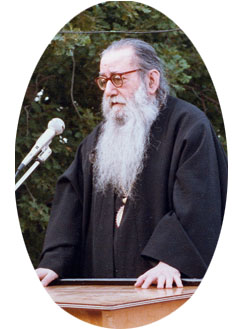
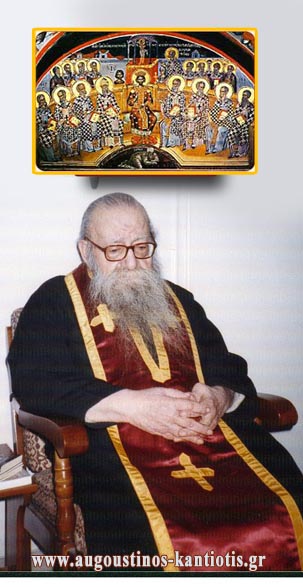
π. Αυγ.The name of bishop of Florina father Augustine Kantiotes is known to the panhellenic region and abroad for his multifarious struggles that he conducted and conducts for the purpose of restoring society and the glory of the Church. For more than a century he is struggling in various directions, without however retreating, with leader the Lord Jesus Christ, with prototype the fathers of the Church and with firm canon the God-inspired canon of Holy Scripture.

A particular mark of the struggles of the hierarch and bishop of Florina is censure. According to the word of apostle Paul, to atheists and antichrists, to insulters and God-mockers, censure is a scandal and foolishness, but to the faithful believers who love the Church and want to see her free and vibrant, it is a boast. Thus, others on account of censure many reprimand the bishop in various ways and many comment on him irritably. Others, however, love him, humbly accept his rebukes and are benefited by them. To these is appropriate the proverbial saying; “Rebuke a wise man, and he shall love you” (Proverbs 9:8).

Now, while this was, is and shall be the journey of the written and spoken word, as the same (bishop) confesses, recently the accusation was machinated that he did not censure or does not censure or that he censures the weak and not the powerful or that his motives are worldly, political etc.

To this accusation we deemed it necessary to answer with the texts themselves. From the 428 issues of the “Christian Spark”, which is published since 1942, we selected texts in which the impartial reader sees the firm line that the bishop follows, his basic principles of censuring outside and apart from persons, situations, dangers, and interests, the motivations that are not outside of his religious mission, and the aim, which is the repentance of the sinner and scandal-maker, the protection of the others or of both. The censure that the metropolitan of Florina performs is not insult, nor condemnation, but a responsible mission and a debt of love.

***

Many think that censuring is bad thing, which is done at our expense. That is wrong. Not only does it not harm us, but it even benefits us. To be sure, censure is not always pleasant. In all cases, however, it is beneficial. It doesn’t seek what is temporary but what is permanent.

“The sick person”, says sacred Chrysostom, “he who has a fever, who is in danger of the ultimate danger, is not benefited, if I tell him that tomorrow you become king. That which the ill person seeks first is his relief from the fearful disease. And I, imitating the doctor, prepare medicines, the bitter medicines. I use a word that is strong, censuring. I shake the conscience, I threaten with fire and brimstone. I strike the mallet hard in order to heal, in order to produce silver and gold vessels. Yes! The heavy, censuring word adjusts souls. It is preferable for my listener to be burned by my caustic censuring than for him to burn eternally by the flame of that hell.”

Another example, in which one sees what is censuring, is the following; “A person is dirty, untidy and someone tells him: Be careful, you’re dirty, untidy! That is censure, and it isn’t bad. Surely the one censured feels shame, worry, but he is corrected and with censure he is protected from worse evils. Moreover, we have censure when a doctor tells the sick person that he is suffering from purulent tonsillitis and the sick person takes his measures, takes medications and is healed. And in both instances neither does censure perform a bad work, because it shows the true condition in which the one censured is found, nor does the one censured feels that he is being insulted, but quite the opposite he feels the need to thank the one censuring, because with his censuring he protected him from further unpleasant consequences.

Something similar to this is spiritual censuring, too. And if censuring is necessary for our health, for our external appearance, much more is it indispensable for our spiritual journey and the clear knowledge of the evil urges and habits that operate inside us. Still more, the teacher of the Church, the preacher of the divine word and interpreter of holy Scripture, he not only has the duty to teach, but also to censure, because holy Scripture, the God-inspired word, as St. Paul says is beneficial “unto teaching and unto censure”. This censure is inspired by love and has as its aim to restore and educate spiritually the one being censured, so that he may become a whole, complete person of God. Wise Solomon writes: “Censure a wise man and he will love you” (Proverbs 9:8). The wise and prudent person accepts censure, because considers it necessary, as an x-ray of his psychical condition (or an x-ray of the condition of his soul). Having this in view too, Paul charges Timothy: “Preach the word, be urgent in season and out of season, censure, rebuke…” (2 Tim. 4:2). When, however, will censuring be done, who will conduct it, and how, is a serious issue.

Censure should be done not when my personal interests are affected, nor when my name is insulted, but when the interests of God are affected, when the name of God is defamed and insulted, when the laws of God are trampled. Then censure is an imperative duty.

But who will conduct this work?

To begin with, those who devoted their life to the Church and live for the Church, those who with feeling and consequence work for the spreading and glory of the Church, those have anxiety for the salvation of souls and go from place to place to find the lost (sheep), those who are real shepherds and teachers who sacrifice themselves for the flock and don’t exploit the flock – all these people are obligated to conduct censure.

But the most difficult consideration is how they will conduct it. What will be the motivations of the one censuring? Perhaps self-projection? The defamation of the one censured? Vindictiveness? Or the satisfaction of evil instincts” No. Censure ought to begin with love and have the truth as its content. Only then is censure salvific, its aim holy, and the results marvelous. Only then is the one censured benefited, is chastely educated and corrected. But also only is orthodox dogma preserved intact, which is the source and support of orthopraxia, that is, of right action.

Surely censure should be performed for all things done secretly and particular places, for this reason censure must be done in private. For all those things, however, that are said and done publicly and that scandalize the consciences of the faithful believers and that provoke corruption, censure is conducted publicly in accordance with the word of the apostle Paul: “Those who sin before all censure, so that the rest have fear” (1 Tim. 5:20).

With this mentality father Augustine censured during the dictatorship of Metaxa. He censured during the Italian and German occupation and many times he was in danger of the invaders, not politically, but religiously and ethically. But censure was not directed only to persons standing in high places in the state; he directed himself also to persons standing in high places in the Church, archpriests, archbishops and patriarchs.

He always censured moving within the religious and ethical circle, having as principle the Chrysostomian word: “Make friends for the sake of Jesus and enemies for the sake of Jesus”. “The bishop does not judge”, he says, “the bishop does not have the authority to judge the personal life of anyone, he doesn’t enter in to the bed chambers of the high-priests, he doesn’t do the work of an ‘uncorker’…He censures, however, those actions of clergy and laity, and indeed of those who possess official seats, which are performed during full noon-time and scandalize the whole people. Condemning doesn’t benefit, the censuring of those, however, of whom it is proved that they sin in public, is salvific and anticipates the further corruption of society”.

Censure never is supported by scandal-monsters. Without at least two eyewitnesses and ear-witnesses, who are ethically and ecclesiastically blameless, no accusation against a cleric can stand.

Many times there come to light scandals, which are based on rumors, without eyewitnesses and ear-witnesses presenting themselves as witnesses. He (bishop Augustine) never became an accuser of such kind of scandals, nor did he base himself on rumors in order to conduct censuring. Various journalists and other ecclesiastical factors wanted him as an advocate and pioneer in their struggles, but he himself didn’t get involved, because their dispositions were not pure and edifying.

He never resorted and does not resort to mud-slinging. Mud-slinging is not censure, but the minimization of the one censured in a dishonorable manner. Quite the opposite, many who studied in great detail his written and spoken discourse, did not find a single derisive remark, resorted to a mud-slinging campaign in order to diminish his authority and defame his name. The censuring of the bishop are based on unshakable proofs, and for this reason, whenever he was led to punitive and ecclesiastical courts, he always came forth victor having the truth on his side.

Father Augustine censured and censures always with pure motivations. In the article of “Spitha” (“Spark”) “Censurers, but not “uncorkers” his motivations are clear. But in a multitude of articles of “Spitha” and of “The Cross” and other books the impartial reader sees the aspiration of the Bishop to see the Church wholly good, wholly beautiful, “not having spot or wrinkle or some-such thing”, to see society released from scandals that provoke bleeding and provoke corruption, to see our fatherland with Christ as governor. This aspiration moves him to censure, for a Church free and vibrant and a healthy society.

It would have been pleasant for father Augustine, as sacred Chrysostom also says, to develop subjects that delight the readers and listeners and not to displease them. It would have liked to play the flute, and the bishop plays it beautifully, but before the dangers, before the wolves that threaten the flock of Christ, he leaves aside the flute and grabs the slingshot. When ravening seek to tear the flock to pieces, we are obligated to leave the flute, the peaceful word, and to go down into the struggles, into battle against the fearful enemies. And this so that our enemies do not win even one sheep from our pen.

What do we do in behalf of sinful women?

author Posted by: episkopos on date Ιουλ 2nd, 2010 | filed Filed under: English

What do we do in behalf of sinful women?

Believe me, my beloved, that whenever I read this moving story of saint Pelagia and of saint Taisia, who are honored on the same day, I am moved, cry, and direct pitiful words against myself, because neither I nor any other of today’s bishops and clerics dares to lead a holy crusade for the salvation of tens of thousands of sinful women, who rot in the caverns of debauchery and of corruption.

O lord, raise up in our epoch, an epoch of Sodom and Gomorra, such holy men, who, devoid of the pharisaical spirit, will show divine interest for the salvation of multi-multitudinous prostitutes…

We must not forget, my beloved, that, in the filth of debauchery, in which thousands of women live, being led astray there for various reasons, there are also hidden diamonds, which must be drawn out. O readers! In the other world we will see surprises. We will see sinners in paradise on account of their sincere repentance, and “saints”, “most holy ones”, “most reverend ones”, “most blessed ones”, and “all-holy blessed ones” – until when these titles? – in hell on account of their hypocritical and pharisaical life.

(Excerpts from “Christian Spark” 56th year – Athens – November- December 1990 – Issue No. 476, Ecclesiastical Issues: “And Again the word to those who are Scandalized” by bishop Augustine, p. 3).

THE SACRIFICE (Η ΘΥΣΙΑ)

author Posted by: episkopos on date Ιουν 19th, 2010 | filed Filed under: English

Απόσπασμα από τό βιβλίο του πατρός Αυγουστίνου
«Είς τήν Θείαν Λειτουργίαν, Πρακτικαι Ομιλίαι»!

Ομιλία 10

Η ΘΥΣΙΑ


Η μετάφρασι ολόκληρου του βιβλίου (δύο τόμους) στά Αγγλλικά έγινε από τόν ακούραστο εργάτη καί αγωνιστή της Ορθοδοξίας, πνευματικόν τέκνον του π. Αυγουστίνου, π. Αστέριο Γεροστέργιο.  Προσφέρεται ταπεινά καί μέ τήν έν Χριστώ αγάπη είς ψυχικήν ωφέλειαν Ορθοδόξων Χριστιανών απανταχού της γης και επισκεπτών της ιστοσελίδας του σεβαστού Γέροντος Αυγουστίνου
πρός δόξαν του Τριαδικού μας Θεού.

THE SACRIFICE


“… Crucified for our salvation under Pontius Pilate, He suffered and was buried.”

Σταυρος 1020 ΦλωρινηςDear friends, our Lord Jesus Christ Himself said: “the Son of man came not to be ministered unto, but to minister, and to give his life as a ransom for many” (Matt.20:28).  That is to say, he did not come to be served as the ancient kings were served by their many subjects, but unlike the great and powerful people of this world, He came to become a servant, a slave of all men.  Christ, the King of kings and Lord of lords, who governs the entire material and spiritual universe, before whom angels and archangels tremble, left all His glory and appeared on earth as a man, a very poor and insignificant man.  No one could ever imagine that, under this lowly image in which Christ appeared, God was hidden.  Even the devil was mistaken and became captive.  Like the fish that sees a lure and does not suspect that there is a fish-hook beneath it, so it was with the devil.  He saw a man with flesh and bones like any other man, and he thought he could easily defeat Him as he did countless other men.  But in the end he faced the tremendous power of Christ, the son of the Virgin , the Son of God as well.  Hades was defeated.

Christ served humanity more than any other person.  His earthly life was one of continuous service, continuous sacrifice.  The Apostle Peter, who followed him closely and knew the details of His earthly life, said that Christ “went about doing good” (Acts 10:38).  This means that Christ spent His whole life giving the world the light of His teaching, doing good to His friends and enemies alike.  Yes, His entire life was one continuous sacrifice.

To give an example, imagine, dear friends, a ladder with its top in the stars, a ladder with countless rungs, the bottom one being on earth.  Imagine someone descending on that ladder, down to the last rung, that on the earth.  This is an image of the humiliation, the sacrifice which Christ made.  Christ came down to this earth from the heavenly heights, lived and walked like a poor and insignificant person, and in this way He served and helped mankind.  And descending the rungs of humiliation, He reached the last one, on which He was crucified.  Christ’s crucifixion is the deepest humiliation, the greatest sacrifice offered to humanity, surpassing any other sacrifice – an Infinite Sacrifice!

Mankind was well acquainted with sacrifice.  It knew of people who were sacrificed for the good of their fellow.  One such sacrifice is that of the ancient kings of Athens, Codros.  Codros saw that the people of his kingdom could not be saved unless he himself would be sacrificed.  He left his palace, took off his royal garments and, dressed like a peasant, went out of the city which was under enemy siege.  His enemies captured and killed him, and in this way he caused the siege to end and saved the city.

The sacrifice of Codros, however, as well as all those of any noble heroes for the good of their fellows, cannot be compared to the voluntary sacrifice of the God-Man Christ on Golgotha.  This is because those were sacrifices of men for men, but the sacrifice of Golgotha was a sacrifice of the God-Man for men.  Their sacrifices saved only a few people from bodily danger, but the sacrifice of Christ saved all humanity from the greatest danger, the danger of spiritual perdition from sin.  He liberated the human race from guild and the curse.  He reconciled God and mankind.  He united heaven and earth, extending worldly and supernatural gifts, and granting grace like an inexhaustible river everywhere, throughout all time to every generation.

Christ is the salvation, the peace and the hope of the whole world.  What Christ did for mankind no other sacrifice could have done – no other heroic deed done by the children of man can match it.

These are not empty words, but a reality which all those who believe in Christ actually feel in their hearts.  Human beings, angels and archangels did not save us, but Christ: to Him is due all the honor and glover forever.

The world’s salvation by the precious Blood of Christ is an event of universal importance, and event-mystery.  Human reason cannot comprehend how Christ’s Blood became a ransom for humanity.  This event, a hidden mystery of divine wisdom, before the Gospel was written, before it had been proclaimed everywhere as an article of the Symbol of Faith, this event was prophesied centuries before.  Anyone reading the Psalms, the Prophecies would think that those God-inspired writers, who lived 800 and 1000 years before Christ, were actually present at the crucifixion and heard and saw what took place.  But of all the prophecies, we will mention only one, that famous prophecy of Isaiah, which is read at the Service of the Sixth Hour on Great Friday.  Isaiah describing Christ says: “He bears our sins, and is pierced for us; yet we accounted him to be in trouble and suffering and in affliction.  But He was wounded on account of our sins, and was bruised because of our iniquities: the chastisement of our peace was upon him; and by his bruises we were healed.  All we as sheep have gone astray; every one has gone astray in his way; and the Lord gave him up for our sins.  And he, despite his affliction, opens not his mouth” (Isaiah 54:4-7).

This is only one part of Isaiah’s prophecy, which, because of its importance, is read twice on Great Friday.  We will not try to explain the whole prophecy, but we recommend to those who are young and have a good memory to open the Holy Scriptures, find this chapter, learn it by heart, and say it like a hymn of the Crucifixion to remember Christ’s Passion with thanksgiving.  “He bears our sins… .”

Christ was crucified, sacrificed for the salvation and life of the world.  He offered Himself as a blameless sacrifice, which is continued through the Mystery of Holy Eucharist.  But, how do we know that this sacrifice was accepted by the Heavenly Father?  Proof is offered by His Resurrection.  His Ascension into heaven, Pentecost and twenty centuries of Christianity, a history of miracles!

To Christ, the Redeemer of our souls, belong glory, honor and thanksgiving now and forever.

With these few and meager words, dear friends, we have tried to explain articles 4 through 7 of the Symbol of Faith.

This chapter was taken from the book “ON THE DEVINE LITURGY – VOL.2” by Bishop Augoustinos N. Kantiotes.

Translation by
Rev. Fr. Asterios Gerostergios
e-mail: ibmgs3@verizon.net
www.orthodoxinfo.com/ibmgs

Our beloved children,

author Posted by: episkopos on date Ιουν 14th, 2010 | filed Filed under: English, ΣΥΜΒΟΥΛΕΣ ΓΙΑ ΝΕΟΥΣ

By the Metropolitan of Florina, Fr. Augustinos

Our beloved children,

Εξομ. π. Αυγ. ιστAs I direct my word to you, I feel very moved. Three feelings dominate in my soul. The one is joy, the second is sorrow, and the third is worry.

I rejoice, because it is no small thing in the contemporary world, in this epoch of atheism and unbelief, to see hundreds of children, boy and girl students of junior high and high school, like thirsty dear running to the well, to the teaching of our Lord Jesus Christ, in the catechetical schools. This consoles us and enthuses us a great deal. That’s why I feel joy and glorify God.

However, I also feel sorrow, because as bishop I ought to have been your catechist (religious instructor), the catechist of all the children of my diocese and even of little children too, because that is the most important work of the bishop. So I ought to have taken on the job of teaching of children, of teaching in all the classes of religious instruction in the schools of the Metropolis.

I remember the unforgettable years, when as a preacher I went to different cities of Hellas and didn’t have the heavy weights of the episcopal office; I had many classes of religious instruction and my joy and gladness was to shepherd the lambs of Christ. Unfortunately now I must confess, that I am found far from the youth of the fatherland. And this, because in my old age I have taken on a heavy cross, the burden of my Episcopal duties.

But on fact minimizes this sorrow of mine: that I have entrusted the catechism of children not to professionals, but to noteworthy missionary persons, clergy and laity, men and women and even girls, who work unselfishly in the Lord’s farm. These people were at other times students of the catechetical school and they know very well the incalculable value that catechism or religious instruction has, in the formation of the Christian character.

So they speak from experience and from their sense of duty. To these persons, who worked with zeal, our Church expresses her pleasant satisfaction. The catechetical school is the only school that doesn’t pay. The religious instructor doesn’t receive even a penny. And yet, it is the only school the world hates mortally.

Here beside us in Albania, no Sunday school was allowed to function. The priest was not allowed to approach and catechize the children.

***

So the one feeling I sense is joy, the other sorrow, and the third worry.

I, the old bishop, worry a lot. I heard you with joy and gladness, children, singing and chanting. You seemed to be nightingales that sing in the forest. But the question arises: After three years, after five years, ten years, when you grow up, when you go to university and receive your diplomas, when join the army, when…, when…you get married, will you continue to have this fervent feeling, which you have at this moment?

I doubt it and worry. Because I know that this shameful society of the 20th century – not only in Hellas but everywhere – , which unfortunately has the name that it is Christian; 95% of it is antichristian. Within this society that children live, they meet many obstacles, which don’t allow them to form a stable Christian character. Everything pushes them to atheism; the radio, the television, books, teaching, the whole climate of society is contrary to the Christian faith and morality. And it is heroism in these years of ours for a young man to believe in Christ. For this reason those who believe are few, a minority in this world. But as few as they are, in our days the saying is realized: “Out of the mouths of infants and sucklings I shall create praise” (Psalm 8:3; Matt. 21:16).

These children are few. But as few as they might be, they have within them an indefatigable militancy for the supporting of the Orthodox faith. To these heroic children, the children in whose veins flows the blood of heroes and martyrs, we must remind the saying: “Resist the devil, and he shall flee from you” (James 4:7). Resist the devil and he will distance himself from you.

Few are these children in relation to the majority of youth, in relation to the world of atheism and unbelief. To these children, who with so much yearning go to catechetical school (religious instruction), I would like to say the following.

My children, as few as might be, have no fear. Only be careful not to be led astray by the current of evil. For this reason I will remind you of the following myth of Aesop.

At one time a fox was captured in a trap and her tail was cut off. She remained crippled. How can she now return without a tail with the other foxes? She couldn’t; she didn’t feel well. Then she thought to make the other foxes cut off their tails. So she went and called all the foxes from the forest and made a speech, being careful all along, however, for them not to see that she didn’t have a tail.

My beloved sisters, she says! God did many good things for us. They made us the smartest animals in the world. We live well. We have brains, intelligence and cunningness. We go to the chicken pens, grab the chickens, eat them, and we get along wonderfully. We have everything. But we have one fault. God gave us something that we don’t need.

-         What? said the other foxes.

-         Why here, he gave us a tail. And it gets all caught up, and it doesn’t allow us to move comfortably. For this reason I propose here at our convention, to cut our tails, so we can become more mobile, more free, but also more beautiful.

-         You speak correctly, said the foxes. Let’s cut our tails.

Then an old female fox gets up and says:

-         Let’s see, does she have a tail?

When they saw her ugliness, they all disapproved her. Because she didn’t have a tail, she would recommend to the others, too, to cut off their tails. In this way they comprehended her cunningness and didn’t cut off their tails.

The myth indicates. If a girl loses her honor, she immediately calls her friends and tries to lead them astray, to make them like her. For them to lose their honor. Because she was corrupted, she wants all the girls to be corrupted. This is a mania, a form of envy, of evil, and a catastrophe.

Thus also does the person with tuberculosis; he who suffers from tuberculosis. In earlier times, those who had tuberculosis would spit in oranges, in order to transmit their illness to others, too. Because they had tuberculosis, they wanted to make others have tuberculosis. That’s what girls that have been corrupted do; they want to transmit their corruption to as many other girls as possible. So stand as far away from such corrupted girls and boys. They’re foxes without tails.

And let the boys and girls steer clear from children who smoke. A boy of 12 years old, who began to smoke, tries to make all his other friends smoke.

So, far from such persons. The children of Hellas, the Christian children, must offer resistance, must resist against evil, which is found around them.

***

I said at another time too, and I repeat it here now, and I won’t stop repeating it. When I was a preacher, up on the high mountains of Grevena, there where the wells of Aliacmona are, I saw one thing: I saw the waters of the river, that as many fish that were dead, the water took them, and went down to Thessalonica. As many fish that were alive, these would go against the current.

My children! Be live fish of the great fisherman, of our Lord Jesus Christ. Go against the faithless and corrupt society. Against your father and mother, when they are faithless and push you towards atheism. Go against the teachers and professors, if they deviate from their destiny and preach unbelief and atheism to you. Go against faithless and perverse society. Go against that global current of corruption. Against all the demons. We shall resist as Hellenes, as Christians. And you can be sure, that as few as you might happen to be, the atheists and faithless shall not conquer; the faithful shall conquer. Because really Christ did not die, but lives and reigns unto the ages of ages.

Now an old bishop, who am found at the end of my earthly life, after living a life of hardships and difficult adventures of so many decades in the fatherland, I recommend to you the following:

If, children, a time comes, not in a theater but in reality we too hear “Persection!”, and priests and bishops grow faint-hearted and the churches are led astray so that they dissolve the Gospel, offer resistance. Whatever happens in Albania and whatever in other far off countries, will happen in Hellas too; I prophecy. But know one thing very well; the atheists won’t be victorious, the faithful will conquer. You, my children, as few of you as might remain with Christ, have no fear; you shall conquer. And even if, my children, child of the catechetical, religious school, a child of Hellas, of Macedonia, of Asia Minor, and of Pontus, and even if your mother and your father denies you and you remain alone in your city or your town, and if all society kneels before the devil, you don’t kneel. Fight him. And you the one shall conquer.

I said it before and I stress it again. Other lands may bow down. But Hellas, which is painted with the blood of saints, shall not kneel down. In your veins, of the small and great, flows the blood of martyrs. Our land shall remain a fortress of Christ. We shall prove yet another time, to the utter dismay of demons, that Christ didn’t die, but lives unto the ages of ages.

Your spiritual father

(This was a homily delivered to boy and girl students of catechetical, religious schools during a celebrative function in the city of Ptolemaida, in 1978).